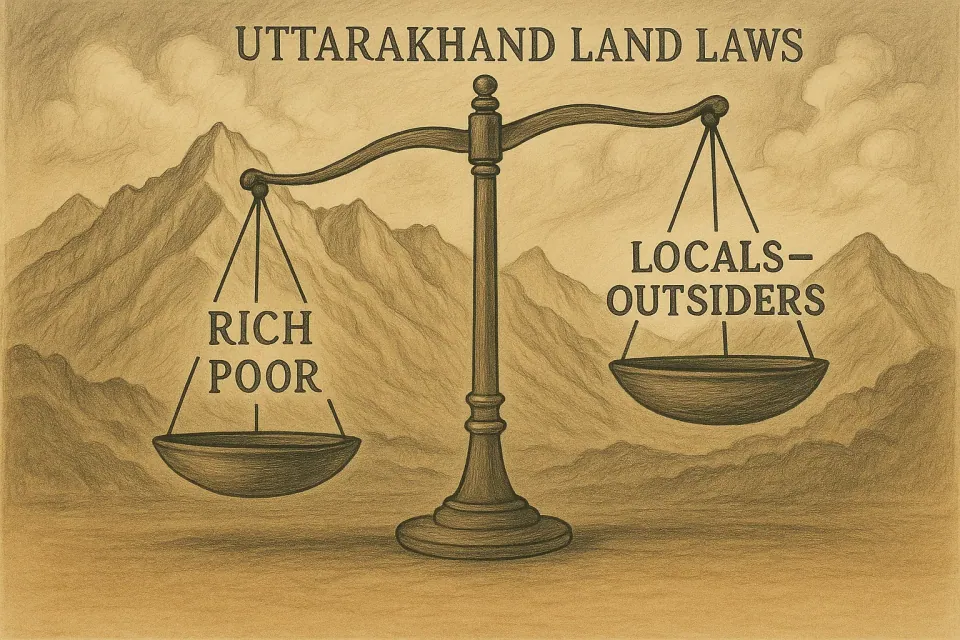
The Quiet Undoing: Paradox of Uttarakhand's Land Laws
A deep dive into Uttarakhand's Land Laws. The intentions and insights. What was meant to safeguard locals has, instead, fortified the hands of the wealthy.
The most complex subjects become easy to understand if we convert them into a story.
This is one such subject that demands storytelling. A sensitive but dramatic story. A story that embraces diverse emotions- ambition, envy, love, agony, jealousy and hope.
As I always do, I am going to start this story from when it was not even born.
It was 14th day of August in 1947, at midnight, first prime minister of free India gave a speech, bits of which were to be recited over and over again in years to come.
“At the stroke of the midnight hour, when the world sleeps, India will awake to life and freedom”
“We have to build the noble mansion of free India where all her children may dwell.”
We all thought that it was the day when India got freedom from all the ‘outsiders’ and left behind were all her children.
India’s territorial journey began with a mosaic of Provinces and Princely States. Through successive reorganizations marked by mergers, divisions and boundary realignments over the years, the nation has gradually arrived at its present structure of 28 States and 8 Union Territories.
It took over 2 years and 11 months for the 299 members of Constituent Assembly to put together the world’s longest written constitution of the time- The Constitution of India- which came into effect in January 1950.
When the opening phrase of the preamble said, “We the people of India…”, it was a loud and clear declaration that the constitution derives its power from the people themselves through collective will as it was formed by Indians for Indians.
Article 19(1)(d) and 19(1)(e) of this great document said that every citizen has the right to move freely throughout the territory of India and to reside and settle in any part of Indian territory.
Choosing any part of country to be their home was the constitutional right of Indians.
This story starts in 1971, when Himanchal Pradesh became the 18th Indian state of the time. The state government was concerned that outsiders will bring in their money to buy limited cultivable land and disrupt the sensitive Himalayan ecosystem. Now the question was who is an outsider in a newly formed Indian state? How does one become an outsider in their own ‘home’ in their own country?
Himachal Pradesh Tenancy and Land Reforms Act, 1972 said that anyone who is not a ‘Himanchali’ or even a localite who is not involved in agriculture is an ‘outsider’ and cannot buy agriculture land (big or small) within the state boundaries without state government’s permission.
Very well intended. Loophole? Several- but the most evident one was it did not restrict local Himanchali Agriculturists to procure more and more land. Result- today hardly 11.4% of landholders manage over 43% of agricultural land in Himanchal. Many Himanchali cities even witnessed irrational construction done by insiders and outsiders (with state government’s permission of-course!)
A recent study by IIT Ropar indicated that nearly 45% of Himachal Pradesh is at risk of landslides, floods and avalanches due to unregulated construction and environmental degradation. Interesting event in this Himanchal chapter of our story is when state had restricted outsiders to have ownership effectively putting a limitation on private investors ensuring well-being of not only local farmers but also eco system and environment, what was done to regulate the construction activities done by ‘insiders’ and if government sanctions for lease/ purchase were to be so easily handed out to outsiders then what was the point of this act in first place? Only to restrict the middle class or lower middle-class Indian or to force them into builder housings/ establishments created by those who could somehow dug their way to get the much scarce ownership/lease. To push down the middle class and lower middle class ‘insiders’ and ‘outsiders’ or to pull up the privileged ‘insiders’ and ‘outsiders’?
Imagine yourself as a small-scale farmer in Himachal Pradesh of 1971. You love your home-land. You celebrate your ‘pahadi-life’ every day. Everyday you look at the mountains around you and you fall in love. Much learned people of the time start educating you that since we are a full-fledged state now, rich people and capitalists from Delhi, Punjab and Haryana will come to our lands because of its tourism potential and richness of resources with their bags of money and try to manipulate you into selling your small piece of land. These modern-day sages tell you that soon everyone will fall into trap of rich outsiders and all our small fields will be bought overnight. At least with this act, your land will always remain in Himanchali hands. Without this act you will become a tenant/ servant in your own land. The painted picture was scary and absolutely possible. That could have happened. You got worried and decided to support the act after all protecting Himanchali identity and resources is your responsibility too. Also, it will help you to create a safety net from powerful outsider capitalist. You instantly got onboard and excited. You trust the goodness of local Himanchali’s.
Life happened. Productivity in hill agriculture on a small land piece is low, input cost of seeds, fertilizers & labour is increasing, due to extreme climatic conditions crop failure is nothing new, your kids need money for education, your parents need money for medical care and family needs are constantly increasing. What if you sell this land, get some money, pay the bills/ debt, get a government job or start a tourism related business or simply go to some bigger city in neighboring states and find a job, that will solve many immediate problems.
But wait! You cannot sell to any buyer from outside and local big landowners are not offering good prices for your land. They know you do not have any other resort. You can see your hopes getting converted into agony. Suddenly you realize that it was never Outsiders vs. Himachalis (or locals), it was and has always been big vs. small/ rich vs. poor be it insider or outsider.
Just as history is written by victors, success and failure of any policy in our country is written, narrated and marketed by the ones who formulate it and benefit from it. No wonder this land law looked attractive to decision makers of other hill states.
Taking inspiration from Himanchal Pradesh, Uttarakhand started adding it’s own chapter to this story. Soon after it was carved out from Uttar Pradesh in 2000, a debate on the land-laws of Uttarakhand took momentum. A fear was created among locals that a small hill state with fragile ecology would be swamped by outside investors and builders if land protections weren’t in place. Once again another newly formed state of free India was on its way of defining who belongs and who doesn’t. Very conveniently, overlooking the irony that on one hand smart-learned-aware people are advocating no outsider should be able to expand their presence in the state but on the other hand Uttarakhand is one of the highest migrating states in the country. Locals from Uttarakhand (and for that matter Himanchal also) are freely migrating to ‘outside’ states without hesitation seeking jobs, education and getting settled without any restrictions or limitations. The migration rate of rural and urban Uttarakhand is 344 and 486 respectively which is way more than the national average of 261 and 354 respectively.
Simple logic says that if you do not want people to come to your home you should first stop going to their home. Ever seen a naughty kid who is reluctant to share his toy because he feels he has few but precious ones, yet he is adamant and assertive in claiming toys of other kids at playtime. As a responsible adult you will tell that kid- it is not fair. Right?
Something similar.
Let us try to understand the Uttarakhand’s Act and the intention behind it.
Although this Act has a long and complex history in Uttarakhand but that’s a discussion for another time. Let’s jump directly to May 2025 when an amendment was added in the Uttar Pradesh Zamindari Abolition and Land Reform Act, 1950 extending to all the rural areas of Uttarakhand. As per this amendment a family can not possess more than 250 square meters of land for residential purpose.
However, two districts- Haridwar and Uddham Singh Nagar have few exemptions. If state government is convinced that any trust, institution, company, firm, a registered co-operative society or a charitable institution needs excess land than the prescribed limit of 12.5 acres as per the principal act for some industrial use/ medical/health purposes/education purpose/ horticulture or processing units/ tourism activities then such bodies will be allowed to purchase more land. Now how to convince state government that their project is in public interest? As per the amendment, the concerned department will review the proposal in terms of investment, employment generation, plant, machinery etc. and issue a ‘land essential certificate’ to authorize the purchase of excess land.
Another exception says that if someone wants to have the land in any other districts of Uttarakhand for agriculture, horticulture, alternate energy projects then they can have it on a 30year lease.
To understand it simply- land procurement for residential purposes by common people of country is restricted but there are ways for big players to procure land for ‘public benefit’ projects.
Since, there is no clear information in public domain on the exact rational behind this decision, multiple school of thoughts are being debated. Protecting interests of locals, making sure that locals do not become landless in their own land, protecting culture and identity of Uttarakhand, check environmental degradation, preserving farm land and livelihood of farmers, etc. One statement that is constantly stealing the thunder is ‘to check the infiltration of outsiders in the state and protect the state from outsiders!’
Again, who is an outsider?
Widely accepted definition of an outsider here is ‘someone who is not originally an Uttarakhandi’.
In black and white, if we dig enough, an outsider is someone who is not a Bhumidar (those who acquired ownership rights over agricultural land when the Zamindari system was abolished in 1952 in Uttar Pradesh and later applied to Uttarakhand) or someone who is not a tenure holder as on/before December 2003.
A critical analysis screams haste and dilution of intent. Here’s how: the amendment says anyone can buy as much land as they want in Urban areas (which are already suffering from over congestion) but in rural areas there is a ceiling limit of 250sqm per family. This translates as an invitation to numerous people (families) to own small land pieces across rural landscapes. On one hand it aims to check the haphazard construction to save the mountain from environmental degradation but on the other hand it inadvertently encourages increase in the built-up density even in the rural areas.
If truly the intention is to control the built-up density and reduce infiltration of ‘outsiders’ to protect the local culture, the land laws should make sure that the population density is also managed by increasing the average plot size in rural areas at-least. The current amendment creates an ecosystem where the pressure on urban infrastructure will keep increasing to accommodate insiders & outsiders and local riches can keep increasing their land banks. In the process, locals looking to sell their asset at the hour of need will likely be left with little choice but to accept terms dictated by these influential landowners.
Another imbalance will be created in the land prices of the urban areas and rural areas. The prices of unrestricted scarce urban land will shoot up multiple folds making it practically unaffordable to middle or lower middle class. This will eventually result in concentration of land ownership in the hands of few elites of the state. Whereas rural areas will observe an increase in lower middle class and middle-class population, sudden increase in built up density, increased load on public infrastructure, services and resources. What rural areas will also witness is a sharp decline in land prices.
So, the ‘rising action’s peak’ in the story is, once again the turkeys have voted for Christmas only to find themselves on the table when the feast begin.
What unfolds next is a familiar irony: laws crafted in the name of protection gradually turn into instruments of exclusion and control. The rhetoric of preservation morphs into the practice of possession. The very clauses meant to secure the hills for their people risk pushing them to the margins of their own land.
How can these land laws avoid turning into a new face of land lobbying when, in the name of protecting the locals from becoming landless, the land is steadily being concentrated in the hands of a few affluent players?
While claiming to protect the local culture from outsiders by restricting the extent of their presence, it paradoxically opens new doors for even more of them.
While it speaks of curbing haphazard construction to save the fragile hills, it ends up sanctioning a higher built-up density across the state.
In the end, the narrative circles back. The protectors become the profiteers, locals the spectators and the hills, once again, the collateral in a story of well-meaning deception told in the name of their preservation.